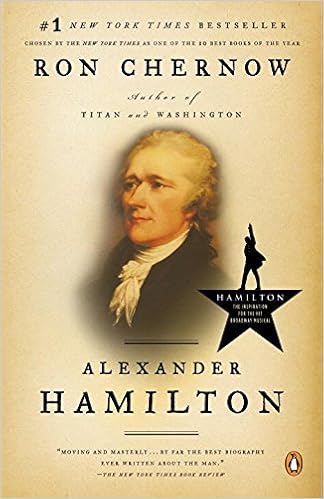
I am reading Ron Chernow’s biography of Alexander Hamilton (the book providing much of the source material for the musical). It is an engaging telling of an incredible life, and I highly recommend it.
A large part of Hamilton’s appeal is the story of his journey from his beginnings as an illegitimate child from the island of Nevis (far distant from the global centers of power and intellectual life, but an opportune place to learn the functioning of a nascent capitalism based on commerce and slavery) to becoming one of the most powerful statesmen and institution builders in America. Naturally, the reader of his life is drawn to the psychological qualities, emotional factors, and personal relationships that motivated him through this journey, all of which Chernow describes in a rich narrative. What strikes me most in this story is Hamilton’s awareness of himself as an historical figure: he deeply studied the histories of other places and times and drew lessons from the lives of other historical figures; lessons that he brought to each challenge he faced.  Hamilton is thus an exemplar of how one should read history, and would appear to fit Ralph Waldo Emerson’s description of the ideal reader of history.
Emerson was himself an enthusiastic reader of history (broadly defined), and his prescription for reading history arose from his personal practice. Emerson was born in 1803, one year before Hamilton’s death to Aaron Burr in 1804. And although Emerson only infrequently mentions the “Founding Fathers,” this is perhaps because their presence would have loomed so heavily for his generation. Here are a selection of quotes from Emerson on the topic of history, and how it should be read:
The student is to read history actively and not passively; to esteem his own life the text, and books the commentary. Thus compelled, the Muse of history will utter oracles, as never to those who do not respect themselves. I have no expectation that any man will read history aright, who thinks that what was done in a remote age, by men whose names have resounded far, has any deeper sense than what he is doing to-day.
-Emerson. “History.” Essays: First Series.
Here’s a very similar thought, from one of Emerson’s most famous (and quoted) lectures:
Meek young men grow up in libraries, believing it their duty to accept the views, which Cicero, which Locke, which Bacon, have given, forgetful that Cicero, Locke, and Bacon were only young men in libraries, when they wrote these books.
-Emerson. “The American Scholar.”
In his essay “Intellect,” Emerson begins to explain why this is the correct way to read history:
Every intellection is mainly prospective. Its present value is its least. Inspect what delights you in Plutarch, in Shakspeare, in Cervantes. Each truth that a writer acquires is a lantern, which he turns full on what facts and thoughts lay already in his mind, and behold, all the mats and rubbish which had littered his garret become precious.
-Emerson. “Intellect.” Essays: First Series.
For Emerson, the value of “truth” (whether historical knowledge or humanistic insight) is its function as a lantern to illuminate contemporary problems (incidentally, this is exactly what M.H. Abrams identified as a the defining factor of the Romantic turn in literature in his The Mirror and the Lamp). We read history to better know our present. So how does Hamilton size up to Emerson’s ideal?
We learn that as a boy in the West Indies, Hamilton had access to a modest but well curated set of books, including Machiavelli’s The Prince and Plutarch’s Lives. After his mother died when Hamilton was barely a teenager, all of his books and belongings were auctioned off by the court. Fortunately for Hamilton, and the future United States, he was saved from absolute destitution by the aid of a few key people, including James Lytton who bought back Hamilton’s books. So we know that Hamilton was able to grow his intellect through studious reading and in actively participating in global trade as a clerk to a trading company.
One doesn’t have to look very hard through Hamilton’s writings to see how he informed his life through actively reading history. Here are a few passages from Chernow’s biography that underscore this point:
From the First Philippic of Demosthenes, he plucked a passage that summed up his conception of a leader as someone who would not pander to popular whims. “As a general marches at the head of his troops,” so should wise politicians “march at the head of affairs, insomuch that they ought not to wait the event to know what measures to take, but the measures which they have taken ought to produce the event.” Nearly fifty-one pages of the pay book contain extracts from a six-volume set of Plutarch’s Lives.
-Chernow. Hamilton. p. 111
Hamilton literally donned the persona of Phocion (the Athenian whose story was told by Plutarch) at times to address the public:
Fearing a Tory stampede, Hamilton did what he always did in emergencies: he took up his pen and protested the anti-Tory legislation in his first “Letter from Phocion,” published in The New-York Packet. In plucking the name Phocion from Plutarch, Hamilton cleverly alluded to his own life as well as to antiquity. Phocion was an Athenian soldier of murky parentage who came from another country and became an aide to a great general. Later, as a general himself, the iconoclastic Phocion favored reconciliation with the defeated enemies of Athens.
-Chernow. Hamilton. p. 197
It is clear that Hamilton was not trying to mimic the great figures of antiquity; if anything, Hamilton was the founding father most in tune with the unprecedented economic transformations then taking place, and was best able to predict where the transformation would lead (Chernow calls Hamilton the “clear-eyed apostle of America’s economic future”). But he looked to the past as a way to transcend the myopic vision of his contemporaries, to understand systemic change in societies and economies, and to learn the personal and moral qualities required of those who attempt to guide systemic change. Hamilton knew how to read history.
If you can, read Chernow’s biography of Hamilton. But make sure you read it actively. You will also find Emerson’s own life as worthy of an active reading (I highly recommend Robert D. Richardson’s Emerson: The Mind on Fire).
Emerson’s argument about how to read history may not be novel, but it is clearly and persuasively stated. I close with two older statements that voice a similar theme:
When one reads the poems and the writings of the ancients, how could it be right not to know something about them as men? Hence one should try to understand the age in which they have lived. This can be described as “looking for friends in history.”
-Mencisu 5B:8
(as cited in Robert Bellah’s Religion in Human Evolution, preface).
In this conversing with men, I mean also, and principally, those who only live in the records of history; he shall, by reading those books, converse with the great and heroic souls of the best ages.
-Montaigne. Essays.

