The Elgar Companion to George Herbert Mead

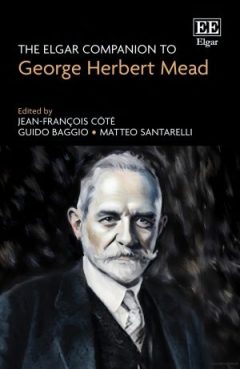
Cover of The Elgar Companion to George Herbert Mead
Standard

It has arrived! I am thrilled to announce the publication of The Elgar Companion to George Herbert Mead!

It was a wonderful experience to contribute to, and learn from, the international and interdisciplinary scholars who participated in this project.

This book not only clarifies key aspects of Mead’s thought, but it also demonstrates how Mead’s ideas have spurred brilliant work in social science, philosophy, literature, and social activism, while remaining a vital source of inspiration for contemporary cognitive science, evolutionary biology, and philosophy of mind.

My deepest thanks to the editors and organizers of the 2024 Mead Symposium at the University of Bologna (Jean-François Côté, Guido Baggio, and Matteo Santarelli), my co-authors (the inimitable Daniel Huebner and Matteo Bortolini), and to all of the contributors and supporters of this work.

Available via Edward Elgar Publishing.

The Powers of Intellect without Conscience

Standard

Some two hundred or so years ago, a series of wars and revolutions brought about an immense transformation in our world. Within the span of a few short decades, a set of British colonies in North America became a new nation and wars spread through Europe, Russia, to the entire globe. Much could be learned by studying the people who lived through these transformations, but one character is particularly relevant today: Napoleon Bonaparte.

Historians and biographers have written libraries on the man, but I will point to a specifically moral lesson to be learned from studying his life, as stated by Emerson:

Here was an experiment, under the most favorable conditions, of the powers of intellect without conscience. Never was such a leader so endowed and so weaponed; never leader found such aids and followers. And what was the result of this vast talent and power, of these immense armies, burned cities, squandered treasures, immolated millions of men, of this demoralized Europe? It came to no result. All passed away like the smoke of his artillery, and left no trace. He left France smaller, poorer, feebler, than he found it; and the whole contest for freedom was to be begun again. The attempt was in principle suicidal. France served him with life and limb and estate, as long as it could identify its interest with him; but when men saw that after victory was another war; after the destruction of armies, new conscriptions; and they who had toiled so desperately were never nearer to the reward,- they could not spend what they had earned, nor repose on their down-beds, nor strut in their chateaux,- they deserted him. Men found that his absorbing egotism was deadly to all other men. It resembled the torpedo, which inflicts a succession of shocks on any one who takes hold of it, producing spasms which contract the muscles of the hand, so that the man can not open his fingers; and the animal inflicts new and more violent shocks, until he paralyzes and kills his victim. So this exorbitant egotist narrowed, impoverished and absorbed the power and existence of those who served him; and the universal cry of France and of Europe in 1814 was, “Enough of him”; “Assez de Bonaparte.”

It was not Bonaparte’s fault. He did all that in him lay to live and thrive without moral principle. It was the nature of things, the eternal law of man and of the world which baulked and ruined him; and the result, in a million experiments, will be the same. Every experiment, by multitudes or by individuals, that has a sensual and selfish aim, will fail. The pacific Fourier will be as inefficient as the pernicious Napoleon. As long as our civilization is essentially one of property, of fences, of exclusiveness, it will be mocked by delusions. Our riches will leave us sick; there will be bitterness in our laughter, and our wine will burn our mouth. Only that good profits which we can taste with all doors open, and which serves all men.

Emerson, R.W. “Napoleon; Man of the World”from Representative Men (1850)

Full text here:
http://www.emersoncentral.com/napoleon.htm

How to Read History: Insights from Hamilton and Emerson

Standard

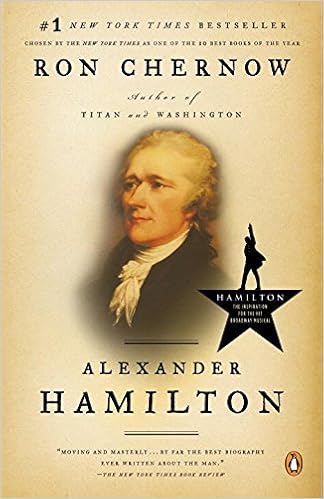
I am reading Ron Chernow’s biography of Alexander Hamilton (the book providing much of the source material for the musical). It is an engaging telling of an incredible life, and I highly recommend it.

A large part of Hamilton’s appeal is the story of his journey from his beginnings as an illegitimate child from the island of Nevis (far distant from the global centers of power and intellectual life, but an opportune place to learn the functioning of a nascent capitalism based on commerce and slavery) to becoming one of the most powerful statesmen and institution builders in America. Naturally, the reader of his life is drawn to the psychological qualities, emotional factors, and personal relationships that motivated him through this journey, all of which Chernow describes in a rich narrative. What strikes me most in this story is Hamilton’s awareness of himself as an historical figure: he deeply studied the histories of other places and times and drew lessons from the lives of other historical figures; lessons that he brought to each challenge he faced. Hamilton is thus an exemplar of how one should read history, and would appear to fit Ralph Waldo Emerson’s description of the ideal reader of history.

Emerson was himself an enthusiastic reader of history (broadly defined), and his prescription for reading history arose from his personal practice. Continue reading

Predictive Modeling and Enrollment Management

Standard

The Challenge: Making Better Predictions to Improve Student Outreach and Enrollment

Technology providers in the higher education sector are now offering new analytic capabilities within CRM and ERP systems, or even as stand-alone services. This presents a potential boon to administrators and enrollment management professionals trying to rapidly adapt to a changing landscape, particularly at smaller institutions that lack the internal resources to build analytic teams. However, it is precisely because these institutions lack internal analytic expertise that vetting technology providers and solutions becomes problematic. This memo responds to several inquiries I have fielded regarding how to incorporate AI (Artificial Intelligence) into predictive modeling to inform institutional practices and goal setting.

Before evaluating analytic methods like AI, it is important to frame the problem within a broader context.

Analytic methods occupy an intermediary role between data and action. The selection of a “good” method needs to respond to what is known about data quality and scope. It likewise has to consider how analytic results will inform strategic action. As a result, instead of focusing narrowly on an analytic method, it is important to continually work through these three steps:

  1. The Data: Quality and scope
  2. The Methods: How to extract meaning from data
  3. The Action: How to use the data to improve outcomes

Improved data quality and scope must always be a priority, just as it is imperative to continually assess new modeling techniques, learn from prior year cycles, and “stress test” possible outcomes. Of course, these improvements only matter to the extent that specific interventions are planned in response to the data and methods.

How do we know which students to direct our scarce resources toward? Let’s look at these three steps in turn:

I. The Data: Improving Quality and Scope

Continue reading